 SV Info
MGA Non GamStop Casinos 2026 — Malta Gaming Authority Framework
This page explains how the Malta Gaming Authority licences online casinos, and what a UK player sees at non gamstop casinos MGA operators. It is a description of the framework, not a recommendation.
What “non gamstop casinos MGA” actually means
The label non gamstop casinos refers to any operator that lacks a UKGC licence and is therefore not required to check the GamStop register. Among that broader group, a small subset holds a Malta Gaming Authority licence and accepts UK residents outside the UKGC framework. Those operators are what UK players usually mean by “non gamstop casinos MGA” — MGA-licensed, but not UKGC-licensed, and therefore not participating in GamStop.
The MGA is a European regulator. It sits within an EU member state, applies EU-derived rules, and publishes a searchable licensee register. In terms of maturity and framework depth, it is regarded as the closest offshore equivalent to a national regulator like UKGC that a UK consumer is likely to meet. That said, “closer than Curaçao” is not the same as “equivalent to UKGC”. The MGA is designed around Maltese and EU law, not UK consumer expectations.
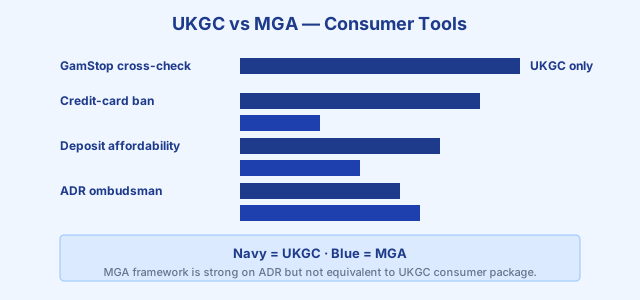
Understanding the intersection matters because it shapes the practical experience. An MGA-licensed operator serving UK residents outside the UKGC framework typically has a fuller consumer-protection package than an equivalent Curaçao or Anjouan operator, but a thinner one than a UKGC-licensed operator. Every UK-relevant tool that the UKGC layers — GamStop, the operator-level credit-card ban, affordability threshold checks, IBAS dispute resolution — is missing or partial under the MGA framework.
This page walks through the framework in enough detail for you to see where the differences sit. It is descriptive, not promotional. Charlotte Hughes has covered the MGA framework since its previous incarnation as the Lotteries and Gaming Authority (LGA) and has followed the transition to the current Gaming Act (Cap. 583). Where facts are stated, they reflect the framework as of mid-2026, and where interpretation is offered, it is Charlotte’s reading rather than an official statement from any regulator.
MGA statutory basis under the Gaming Act 2018
The Malta Gaming Authority was established in 2001 as the Lotteries and Gaming Authority (LGA), taking its current name and expanded scope in 2015. The statutory basis for the modern framework is the Gaming Act (Cap. 583), which entered into force in August 2018 and consolidated a patchwork of earlier acts and regulations into a single umbrella statute. The Act is administered by the MGA, which functions as the statutory regulator for all licensed gaming activity offered from Malta.
The 2018 Act was designed to modernise the framework in three main directions: to make licensing categorisation clearer (B2C, B2B, key function), to align player-protection rules with EU norms, and to strengthen the MGA’s supervisory powers. The Act is supported by subsidiary legislation and by MGA-issued directives, guidance notes and policy documents that give the day-to-day operational detail.
Under the Gaming Act the MGA has powers to grant, refuse, suspend and revoke licences; to impose administrative penalties; to require operators to comply with specific conditions; and to publish enforcement notices. These powers are exercised by decisions of the Authority and are subject to appeal within the Maltese legal system. For a UK consumer the important point is that MGA supervision is real and enforceable within Malta and, by extension, across the EU internal market.
The Act reflects EU membership. Malta is an EU member state, and the framework incorporates EU consumer-protection concepts and EU anti-money-laundering directives. That EU alignment is a material difference from Curaçao or Anjouan, both of which sit outside EU regulatory coordination. The Act is publicly available; a general overview of Malta’s gaming law and the Authority itself is in the Wikipedia entry for the Malta Gaming Authority.
MGA licence categories: B2C and B2B
The MGA framework organises licences into two main categories: business-to-consumer (B2C) and business-to-business (B2B), with additional key-function certifications for specific roles within an operator. A B2C licence covers direct customer-facing operations — the actual casino, sportsbook or lottery product offered to end users. A B2B licence covers upstream services such as game supply, platform provision and payment technology.
Within B2C licences, there are four game-type verticals: Type 1 (games of chance played against the house, so casino games), Type 2 (games of chance not played against the house, so sports betting and horseracing), Type 3 (games of chance played against other players with a peer-to-peer element, so poker and betting exchanges) and Type 4 (controlled skill games). An operator can hold licences across multiple game types, but the licence conditions attach to the specific type.
The B2C licence carries the substantive consumer-protection conditions: player-fund segregation, responsible-gambling requirements, complaint-handling procedures, anti-money-laundering obligations, and technical certification. Duration is typically ten years for a B2C licence, with periodic supervisory review. Compliance failures can lead to conditions being imposed, licences being suspended, or ultimately revoked.
Key-function certifications are personal certifications required for people occupying certain roles within a licensed operator: chief executive, chief compliance officer, money-laundering reporting officer and similar. This is a European approach to personal accountability within regulated firms and is broadly analogous to the Personal Management Licences under the UKGC framework.
MGA player-fund segregation rules
Player-fund segregation is one of the clearest consumer-protection features of the MGA framework. Under the MGA rules, an operator must hold customer deposits in an account separate from the operator’s working capital, at an authorised credit institution located in Malta or another EEA member state. The account is titled in a way that identifies the funds as customer money, and the operator must reconcile the account against internal ledgers on a defined schedule.
The purpose of the rule is to protect deposits in the event of the operator’s failure. Segregation is not a full insolvency-proof guarantee — the details of what happens to segregated funds in insolvency depend on the specific insolvency regime that applies — but it is a real protection compared with frameworks that permit operators to commingle customer deposits with working capital. Under UK financial services law, comparable client-money rules protect customer funds in regulated investment firms; the MGA rule imports similar thinking into gambling.
Where an MGA operator falls short, the MGA can require additional reporting, appoint external auditors or, in serious cases, act on the licence. Publicly available enforcement decisions include cases where MGA operators lost their licence in part because of player-fund handling failures. The framework has teeth in a way the legacy Curaçao framework did not.
For a UK consumer this specific rule matters because it changes the base-rate risk of a large balance at the operator. If you have £500 in your casino account and the operator collapses, an MGA player-fund segregation rule offers you a better chance of recovery than a framework that lacks the rule. Segregation is not a UK deposit guarantee, and it should not be assumed to work perfectly, but it is a meaningful line of defence.
Responsible gambling under the MGA framework
The MGA framework requires B2C operators to implement a responsible-gambling programme covering deposit limits, session limits, loss limits, time-outs, reality checks and self-exclusion. The specific parameters are set by the operator within MGA guidance, and the operator must make the tools accessible on the account interface and encourage their use during onboarding.
Self-exclusion under an MGA licence is site-specific rather than a national scheme. An MGA player can self-exclude from a specific operator, and the operator must honour that request for at least the minimum period defined by MGA guidance, typically six months. Once self-excluded from operator A, the player is not automatically excluded from MGA-licensed operator B; there is no MGA equivalent of GamStop’s cross-operator national coverage.
Reality checks and the responsible-gambling code require operators to display session time, cumulative wagering and net loss information at defined intervals. Where a player exhibits patterns associated with problem gambling — increasing deposit frequency, chasing losses, unusually long sessions — the operator is expected to intervene, though the specific interventions depend on the operator’s risk-based approach.
MGA operators must also publish links to problem-gambling support and offer information about self-help tools. In the UK context, this means the MGA framework provides a partial functional analogue to the UKGC responsible-gambling package, but without the national self-exclusion reach that GamStop provides, and without the specific UK affordability-check approach the UKGC has developed since 2020.
MGA Alternative Dispute Resolution route
Alternative Dispute Resolution is a formal channel under the MGA framework for complaints that the operator’s internal team has not resolved. ADR is provided by bodies approved by the MGA. Operators must respond to a first-tier complaint within a defined period (typically 10 working days) and, if the response is unsatisfactory to the player, the complaint moves to the approved ADR provider.
ADR proceedings are conducted in writing and are typically free to the player. The ADR body reviews the operator’s policies, the complaint facts, and the outcome under MGA rules. Decisions are binding on the operator (subject to appeal within the MGA framework) and are treated as persuasive but not automatically binding on the player. In practice, ADR outcomes at MGA-licensed operators are documented in the ADR body’s public decisions.
Two limitations are worth noting from a UK-consumer perspective. First, ADR does not decide questions of Maltese law, EU law or contract law with the same authority as a court; if the underlying dispute is complex enough to require full legal proceedings, the venue is likely to be a Maltese court applying Maltese law. Second, ADR is not the same as regulator supervision; the MGA reserves regulatory questions (was the licence condition breached?) for its own supervisory process, distinct from the contractual complaint route.
For UK residents, the ADR route is a genuine channel but is slower and less familiar than IBAS at a UKGC-licensed operator. Language may be an issue if the ADR body chooses to use Maltese; in practice English is available for most published decisions. The card-issuer chargeback route remains a parallel UK-side option for unauthorised transactions, though not for straightforward gambling losses.
Anti-money-laundering under EU AMLD5 and AMLD6
Anti-money-laundering rules are a substantial part of the MGA framework and are directly tied to EU legislation. The Fifth Anti-Money Laundering Directive (AMLD5) applied to Maltese gambling law from January 2020, and the Sixth Anti-Money Laundering Directive (AMLD6) came into effect in December 2020. The MGA implements these through the Prevention of Money Laundering and Funding of Terrorism Regulations (Malta) and MGA-specific guidance.
Practical implications for a player at an MGA-licensed operator: identity verification (KYC) at defined trigger points, source-of-funds evidence for larger deposits or cumulative activity above thresholds, enhanced due diligence for higher-risk customer profiles, and periodic re-verification. These requirements are not optional; the operator must apply them regardless of how much you might prefer a lighter approach.
The trigger points are typically stated in the operator’s cashier or customer-verification pages. A common pattern is basic identity verification at withdrawal, expanded checks at cumulative deposits over €2,000, and enhanced due diligence for high-value activity. The specific thresholds vary by operator within the MGA framework.
For UK consumers, the AML framework at an MGA operator looks similar in structure to the UKGC approach, though the specific rules and thresholds differ. Both frameworks are converging on FATF-derived standards, and neither permits an operator to skip KYC entirely for large sums. Where you read marketing copy suggesting “no verification” at an offshore-licensed operator, treat it with scepticism — it is not consistent with any of the frameworks described here.
How MGA differs from UKGC on GamStop equivalents
The most consequential difference for a UK consumer looking at non gamstop casinos MGA is on self-exclusion. UKGC operators must cross-check GamStop and honour any active registration for the term chosen by the player. MGA operators are not required to check GamStop and typically do not, because the MGA framework applies its own site-specific self-exclusion tool rather than a national scheme.
The site-specific model has an obvious asymmetry: a self-exclusion at MGA operator A does not cover MGA operator B. For a UK consumer who has self-excluded via GamStop, moving to an MGA-only operator effectively resets the self-exclusion protection. That is the practical mechanism by which the offshore market is accessible to a GamStop-registered player, and it is the reason the market is treated as sensitive from a UK responsible-gambling perspective.
The MGA framework does not include a UKGC-style credit-card ban at operator level. Credit-card acceptance at an MGA operator depends on the operator’s own risk appetite and the payment processor’s appetite, not on a licence condition. In practice, UK card issuers may still block gambling transactions to non-UKGC operators regardless of the MGA framework, so credit-card acceptance is partial at the UK end.
Affordability checks under the UKGC framework are driven by UK-specific guidance and thresholds. MGA operators apply their own affordability approach under a broader “player protection” obligation, but the thresholds and specific triggers are not the same as UKGC affordability. IBAS coverage — the UK gambling-specific ADR body — is UKGC-linked and does not extend to MGA operators, so the UK-familiar dispute route is replaced by the MGA ADR route described above.
Verifying an MGA licence on the public register
The MGA publishes a searchable licensee register on its own website. The register lists company name, licence class, licence status and licence number. Verifying an MGA licence yourself is a five-minute exercise and is one of the most valuable steps you can take before depositing money with any MGA-licensed operator claiming to accept UK residents.
- Find the licence details in the operator’s footer or About page. Note the licensed company name and the licence number.
- Open a fresh browser tab and navigate directly to the MGA website. Do not click a badge on the operator’s site; badges can be manipulated.
- Open the MGA licensee register. Search by company name or by licence number.
- Confirm the licensed company name matches, the licence class covers the games advertised, and the licence status is active.
- Look for any published enforcement notices against the licence holder.
| Data point | Where to check | Common warning sign |
|---|---|---|
| Licence number | Operator footer, terms page | Missing or graphic-only |
| Licensed company name | Operator terms of service | Different from footer |
| Licence status | MGA public register | Suspended, expired, revoked |
| Licence class | MGA public register | Does not cover the games offered |
| Enforcement notices | MGA public register | Recent warnings or fines |
| Domain coverage | Cross-check operator terms | Domain not listed on licence |
These steps take a few minutes and cost nothing. Given that a licence check is the difference between a licensed operator and an unlicensed operator claiming a licence, skipping this step is a false economy. If any of the data points fails to match, do not deposit; the reason is far more likely to be that the operator is misrepresenting a licence than that the register is wrong.
Frequently Asked Questions
Is an MGA licence better than a Curaçao licence for UK consumers?
MGA rules on player-fund segregation, dispute resolution and responsible gambling are more prescriptive than the current Curaçao framework and are aligned with EU norms. For a UK consumer that translates into more predictable process, though it does not replicate UKGC protections such as GamStop and the credit-card ban.
Do MGA-licensed casinos check GamStop?
No. GamStop is a UKGC licence condition, not an MGA one. MGA operators must provide site-specific self-exclusion and follow the MGA responsible-gambling code, but they do not query the GamStop register.
What does MGA player-fund segregation actually mean?
MGA operators must hold customer deposits in an account separate from the operator’s working capital, typically at a Maltese or EEA-authorised credit institution. Rules govern how the account is titled, audited and reconciled, so that in a solvency event customer funds are identifiable and, in principle, recoverable.
How do you file a complaint with an MGA-licensed operator?
You start with the operator’s internal complaints team. If unresolved, the complaint moves to an MGA-approved Alternative Dispute Resolution provider. If that also fails to resolve, the MGA itself can accept regulatory complaints, though it distinguishes contractual disputes (ADR) from regulatory concerns (MGA supervision).
Are MGA-licensed operators allowed to accept UK players?
Marketing to Great Britain requires a UKGC licence, and many MGA operators either hold both licences or geo-block UK players. Some MGA-only operators accept UK residents outside the UKGC framework; that is the intersection with the non-GamStop segment and is where UK consumer protections are thinnest.
Does the MGA maintain a public register you can search?
Yes. The MGA publishes a searchable licensee register listing the company name, licence type, licence number and status. You can verify any MGA-licensed operator against this register directly.
What is the MGA’s approach to responsible gambling?
MGA operators must offer deposit limits, session limits, time-outs, reality checks, self-exclusion and links to problem-gambling support. The framework is site-specific rather than a national scheme, so an MGA self-exclusion does not carry across to non-MGA operators the way GamStop does across UKGC.
Responsible Gambling
GamStop is a UK consumer-protection scheme; it exists to make self-exclusion durable across UKGC-licensed sites. If you are looking at MGA-licensed non-GamStop operators because your GamStop registration is limiting your access to UKGC sites, please pause before continuing. MGA site-specific self-exclusion does not replace a GamStop registration, and the offshore market removes several UK protections you may not have registered as missing.
Support in the UK is available from GamCare (helpline 0808 8020 133, 24 hours a day), Gordon Moody (residential and online treatment), the NHS National Gambling Clinic (specialist NHS service for adults, adolescents and affected families), BeGambleAware (counselling referrals), and GAM-Anon (peer support for affected others). Do not use borrowed money for gambling. Consider enabling the gambling-transaction block in your UK bank’s mobile app if you have not already.
Wider legal background on gambling regulation in the United Kingdom is available in the Wikipedia entry for gambling in the United Kingdom. UK residents may also find the primary statute useful; it is published at legislation.gov.uk. General consumer information is available on gov.uk.

Charlotte Hughes
Regulation Researcher at SV Info · Last updated 5 August 2026
Charlotte has followed UK gambling regulation and its offshore counterparts since 2016, mapping the gap between UKGC standards and Curaçao/Anjouan frameworks. She writes for SV Info in a UK-academic register aimed at UK consumers weighing offshore-licensed gambling operators.