 SV Info
Licensing Non GamStop Casinos 2026 — Verify, Anjouan and Kahnawake
This page explains how to verify an operator licence yourself, walks through Anjouan and Kahnawake in depth, and lists what an offshore licence does not cover. Written for UK consumers researching non gamstop casinos licensing.
What “non gamstop casinos licensing” covers in practice
“Licensing” in the context of non gamstop casinos is a specific concept: it refers to the formal legal permission held by the operator to offer online gambling under a specified jurisdiction’s rules. This page focuses on the practical UK-consumer skill of verifying, reading and understanding those licences. It is descriptive and does not recommend specific operators or brands.
The reason this matters is that a licence is not decorative. A properly held licence sets rules on how the operator handles player funds, verifies age, applies KYC, publishes terms and resolves disputes. The absence of a UKGC licence — which is what defines the “non-GamStop” category — does not mean the operator is unlicensed. It means the operator is licensed somewhere else, and that somewhere-else has different rules from the UK.
UK consumers often conflate “non-UKGC” with “unlicensed”. The two are not the same. An operator can hold a real, active MGA licence and be non-UKGC. An operator can hold a real, active Curaçao licence and be non-UKGC. An operator can also claim any of the above and hold nothing verifiable. Being able to tell the difference is a five-minute skill that materially reduces your risk exposure.
This page walks through the mechanics. Charlotte Hughes has spent the past decade following the shifts in offshore gambling regulation and has seen how much the practical picture has changed even in the past three years. The starting position for a UK consumer is: verify first, read second, deposit last. This page gives you the tools to do the first two.
The four regulators most UK players encounter
The four regulators UK consumers are most likely to see at non-GamStop operators are Malta Gaming Authority, Curaçao Gaming Control Board, Anjouan Offshore Gaming and Kahnawake Gaming Commission. Each has its own framework, its own public register and its own reputation. This section is a brief overview; the individual pages linked below provide the depth.
- Malta Gaming Authority (MGA) — EU-based regulator with a comprehensive framework covering player-fund segregation, ADR dispute resolution, responsible gambling, and AMLD-aligned anti-money-laundering. Regarded as the most mature offshore-perspective regulator. See the MGA guide.
- Curaçao Gaming Control Board (GCB) — Caribbean regulator moving from the legacy four-master-licence model to the direct-licence LOK framework since 2023. The largest single cluster of licences by count. Framework maturity varies significantly between legacy and LOK licences.
- Anjouan Offshore Gaming — Comorian licensing framework growing as an alternative to Curaçao. Lighter than the MGA or LOK Curaçao frameworks, with narrower supervisory depth. Increasingly common at newer non-GamStop operators.
- Kahnawake Gaming Commission (KGC) — Canadian First Nations regulator based in the Mohawk Territory of Kahnawake, established in 1996. Longer operational history than most peers, modest UK footprint, generally reasonable reputation.
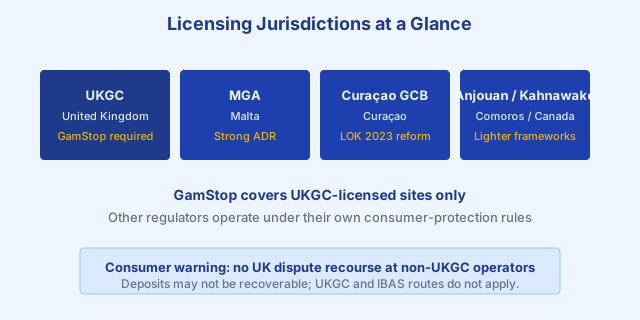
Understanding which regulator sits behind a specific operator is the starting point for any consumer research. The next section walks through how to identify the regulator from what the operator publishes.
How to read an operator footer for licence details
The operator’s footer is where licensing details usually appear. What you are looking for is: the regulator name, the licence number, the licensed company name and, ideally, a link to the regulator’s own register entry. A well-presented footer will include all four in text form, not just a graphical badge. A poor footer will show only a badge with no verifiable data.
Standard components of a reasonable licensing footer include the licensed company name (the legal entity), the company’s registered address, the licence number in a format matching the regulator’s own numbering, and a statement identifying which games are covered by the licence. Some operators also include a short statement about the applicable dispute-resolution route (MGA ADR, GCB complaint procedure, etc.), which is a good sign.
Warning signs at the footer level include: a badge without a licence number visible on hover or click; a licensed company name that is different from the operator’s stated legal entity on the terms page; a licence number that appears to be in the wrong format for the claimed regulator; and a claimed licence from a regulator that does not typically appear at offshore online-casino operators. None of these are automatic disqualifications, but each requires a follow-up check on the regulator’s register.
Cross-reference the footer against the terms and conditions page and the About/Company page. A reputable operator will state the same legal entity, the same licence number, the same registered address across all three. Any inconsistency — a different company name in the terms compared with the footer, for example — is a red flag worth investigating before you deposit any money.
Verifying via the regulator’s public register
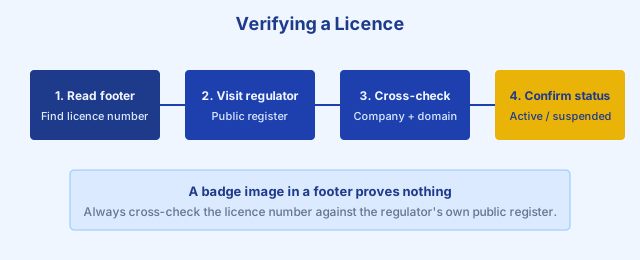
All four regulators discussed on this page maintain public licensee registers. They are searchable by company name and by licence number. Verifying a licence yourself is the single most valuable step you can take, and it costs nothing beyond a few minutes of attention.
- Note the regulator, licence number and licensed company name from the operator footer.
- Type the regulator’s domain into your browser directly. Do not click a badge on the operator’s site — that link can be tampered with.
- Find the public licensee register. All four regulators publish one; the URL varies but a site search usually locates it.
- Search by licence number first, then by company name. Look for exact matches.
- Read the licence entry: status (active, suspended, expired, revoked), class (casino, sportsbook, poker), issue date, conditions attached.
- Cross-check the operator’s domain against those listed as covered by the licence, where the register lists domains.
- Note any published enforcement action against the licensee.
If all data points match and the status is active, the licence is real. If any point does not match, or the licence is suspended, expired or revoked, do not deposit; regardless of how legitimate the operator’s marketing appears, the framework you are supposedly relying on is not functioning. The register is the source of truth, not the operator’s claims.
General regulatory context on offshore online-gambling supervision is discussed in the Wikipedia entry for online gambling, which surveys the international regulatory landscape at a high level. It is a starting point rather than a substitute for direct register verification.
Anjouan Offshore Gaming Authority in depth
Anjouan is one of the four islands that make up the Union of the Comoros, an island nation off the east coast of Africa. Anjouan Offshore Gaming operates under a Comorian legal framework and issues online gambling licences to operators offering casino games and sports betting. The framework has grown in market share since around 2020, particularly as operators sought alternatives to Curaçao during the LOK transition.
The Anjouan framework includes core elements you would expect from any licensing regime: identity verification of operators, anti-money-laundering compliance, responsible-gambling messaging, and a complaint-handling procedure. What differs from MGA or post-LOK Curaçao is the depth of supervisory capacity and the breadth of published rules. Anjouan’s regulatory bandwidth is narrower, and the publicly available detail on its enforcement action is thinner.
For a UK consumer at an Anjouan-licensed operator, the practical consequences are twofold. First, the framework applies fewer prescribed guardrails than the more mature regulators, so the operator’s own conduct becomes disproportionately important. Second, dispute mediation via the regulator is available in principle but is slower and less benchmarked than MGA ADR or Curaçao GCB escalation. The card-issuer chargeback route becomes correspondingly more important as a UK-side backstop.
This is not a claim that Anjouan-licensed operators are automatically problematic. Some operate reputable businesses. It is a claim that the licensing framework is doing less work to protect you than a stronger framework would, so the specific operator’s reputation, published terms and complaint history become the main data points. If those look weak, the licence itself does not compensate.
Kahnawake Gaming Commission in depth
Kahnawake Gaming Commission is based in the Mohawk Territory of Kahnawake, a First Nations reserve on the south shore of the St Lawrence River near Montreal. The KGC was established in 1996 and issued its first online gambling licences shortly afterwards, making it one of the oldest online gambling regulators in the world. Its operating framework is the Regulations Concerning Interactive Gaming.
The Kahnawake framework covers licensing of gambling operators, hosting providers, and key personnel. It requires operators to maintain player funds separately from working capital, conduct KYC in line with anti-money-laundering norms, publish terms and conditions, and offer responsible-gambling tools including self-exclusion. Compared to MGA and post-LOK Curaçao, the framework is well-established but administratively smaller in scale.
Kahnawake’s UK footprint is modest. Most Kahnawake-licensed operators serve the North American market; the crossover with UK-facing non-GamStop operators is smaller than Curaçao’s and much smaller than MGA’s. When you do encounter a Kahnawake licence in a UK-facing operator’s footer, the framework is real and can be verified on the KGC’s public register. The same verification steps apply as for the other regulators.
General background on the KGC is available in the Wikipedia entry for the Kahnawake Gaming Commission. As always, that is a starting point rather than a regulatory source. Verify any specific operator through the KGC’s own register.
What a licence does not cover
Understanding what a licence does not cover is as important as understanding what it does. This section lists the practical gaps that UK consumers should not expect a licence to fill, regardless of which regulator is behind the operator.
| Assumption | Reality |
|---|---|
| A licence guarantees you will win disputes | It sets rules for how disputes are handled; outcomes depend on facts |
| A licence protects your deposit fully | Segregation applies at MGA and LOK; other frameworks vary |
| A licence creates UK jurisdiction | The contract is with an offshore entity under offshore law |
| A licence substitutes for reading terms | Bonus and withdrawal terms are the operator’s; licence sets rules for clarity, not content |
| A licence covers all games advertised | Licence class covers specific game types; check register |
| A licence prevents operator insolvency | No framework guarantees solvency |
| A licence protects against fraud | Licence sets AML rules; individual fraud requires separate action |
The most important point in the table is jurisdictional. A licence is a permission to operate under the licensing jurisdiction’s law, not a UK-law overlay. Even at an MGA-licensed operator, the contract for your play is a Maltese-law contract with an entity registered in Malta. Enforcement in a UK court is possible in principle but expensive and slow in practice.
The second most important point is fund protection. Not all frameworks require player-fund segregation, and where they do, the specific rules vary. Under MGA, segregation is well-defined. Under LOK, segregation is required but the framework is still building enforcement track record. Under Anjouan and some legacy Curaçao licences, segregation is less structured. Do not assume that any licence protects your deposit from operator failure.
Signs of a fake or misrepresented licence
Fake or misrepresented licences are a documented problem across the offshore online-gambling market. UK consumers can protect themselves substantially by learning to recognise the common patterns. The list below is not exhaustive but covers the most common ones.
- A graphical badge in the footer with no licence number visible.
- A badge that links to a page on the operator’s own domain, not to the regulator’s domain.
- A licence number that returns no result when searched on the regulator’s public register.
- A licensed company name that does not match the operator’s stated legal entity in the terms.
- A licence marked “suspended”, “expired” or “revoked” on the register.
- A regulator name that does not match a real licensing body (watch for near-look-alike names).
- A badge for a regulator that does not license the type of gambling advertised.
- Inconsistent legal-entity information across footer, terms and About page.
- Terms of use that reference a completely different regulator from the footer badge.
Where you spot any of these, the response is straightforward: do not deposit. The reason is far more likely to be misrepresentation than a register error. Consumer forums, independent watchdog listings and, where available, published enforcement notices from the regulator itself are all more reliable than the operator’s own claims.
If you have already deposited at an operator whose licence turns out to be misrepresented, the practical routes are limited. Card-issuer chargebacks may work if the deposit is recent and can be characterised as non-authorised or as service-not-provided; Section 75 of the Consumer Credit Act 1974 applies to UK credit-card purchases within the £100-£30,000 window. Neither route is guaranteed to succeed, and both are slow. Verifying before depositing is the only reliable defence.
UK-side consumer routes that still apply
Even at a non-UKGC operator, some UK-side consumer routes remain available. This section describes what they are, when they apply and what their limitations are. None of them is a full substitute for UKGC or IBAS coverage, but knowing they exist is useful.
Card-scheme chargeback is available for unauthorised card transactions under Visa and Mastercard scheme rules. If a deposit was made without your authorisation — a compromised card, a stolen device — the chargeback route is usable. It is not usable for a straightforward gambling loss where you deposited the money yourself and lost it in play. The chargeback window is typically 120 days from the transaction date.
Section 75 of the Consumer Credit Act 1974 applies to UK credit-card purchases between £100 and £30,000. It creates a joint liability between the retailer (the operator) and the card issuer for breach of contract or misrepresentation. Whether a gambling deposit is a “purchase” for Section 75 purposes is not settled, and outcomes vary by issuer. The route is available in principle but uncertain in practice.
Financial Conduct Authority (FCA) rules govern UK card issuers and payment institutions. If a UK card issuer or e-money provider fails to handle a transaction properly, the Financial Ombudsman Service can hear a complaint against the UK-side institution — not against the offshore casino. This is a limited route but real in the right circumstances. General guidance is on the FCA gov.uk page.
General UK consumer law applies to any UK resident contracting with a foreign entity, but enforcement across borders is expensive and slow. Small-claims routes are available in principle for smaller sums; larger disputes require full civil litigation and specialist advice. In practice, this route is rarely used against offshore casinos.
Card-issuer gambling block is a UK-side self-protection tool. Barclays, HSBC, Lloyds, NatWest, Monzo, Starling and Revolut all offer a gambling-transaction toggle in the mobile app. Enabling it prevents further deposits at any gambling merchant on that card, including non-UKGC operators. It does not recover past deposits but it removes the possibility of new ones under duress.
Frequently Asked Questions
Which regulator covers most non GamStop casinos?
Curaçao Gaming Control Board covers the largest cluster by count. Anjouan Offshore Gaming has grown recently. Malta Gaming Authority covers a smaller premium segment. Kahnawake covers a modest population, mostly outside the UK-facing market.
How do you check if an operator licence is genuine?
Read the operator footer to find the licence number and licensed company name, then navigate directly to the regulator’s public register. Confirm status, class and domain coverage. Do not rely on badges alone — they can be manipulated.
Is Anjouan gaming regulation robust?
Anjouan is a lighter framework than either MGA or the post-LOK Curaçao GCB regime. It licences operators and mandates baseline compliance including anti-money-laundering checks and responsible-gambling messaging, but the supervisory depth and complaint mediation capacity are narrower than at the larger regulators.
What is Kahnawake Gaming Commission?
Kahnawake Gaming Commission is an online-gambling regulator based in the Mohawk Territory of Kahnawake in Canada. Established in 1996, it maintains a public licensee register and has a longstanding operational team. Its UK-facing footprint is modest.
What does an operator licence NOT cover?
A licence does not guarantee a specific outcome on any specific dispute, does not create UK jurisdiction over the contract, does not substitute for reading operator terms, and does not protect against operator insolvency in every framework. It is a framework for operation, not a consumer guarantee.
Can you tell a real licence badge from a fake one?
A real badge links to the regulator’s own domain and matches a licence number searchable on the regulator’s register. A fake badge often links to a page on the operator’s own domain, uses an unfamiliar font, or shows a licence number that does not verify. When in doubt, verify on the register directly.
What UK-side routes still apply against non-UKGC operators?
Card-issuer chargeback for unauthorised transactions applies through scheme rules. Section 75 of the Consumer Credit Act 1974 may apply to UK credit-card deposits between £100 and £30,000. General UK contract law is available in theory but rarely practical against an offshore-licensed operator.
Responsible Gambling
GamStop is a UK consumer-protection scheme; it exists to make self-exclusion durable across UKGC-licensed sites. If you have arrived at licensing detail because your GamStop registration is limiting your access to UKGC operators, please pause. No offshore licensing framework restores UKGC-level UK-side protections, and none of them requires participation in GamStop. The information on this page is educational, not a route to override a decision you made to protect yourself.
Support in the UK is available from GamCare (helpline 0808 8020 133, 24 hours a day), Gordon Moody (residential and online treatment), the NHS National Gambling Clinic (specialist NHS service in England for adults, adolescents and affected families), BeGambleAware (counselling referrals), and GAM-Anon (peer support for affected others). Do not use borrowed money for gambling; do not chase losses; enable your bank’s gambling-transaction block if you have not already.
Historical background on UK gambling regulation is in the Wikipedia entry for the Gambling Act 2005, and the primary statute is at legislation.gov.uk. Wider policy context on cross-border consumer protection is discussed in publications from the OECD.

Charlotte Hughes
Regulation Researcher at SV Info · Last updated 5 August 2026
Charlotte has followed UK gambling regulation and its offshore counterparts since 2016, mapping the gap between UKGC standards and Curaçao/Anjouan frameworks. She writes for SV Info in a UK-academic register aimed at UK consumers weighing offshore-licensed gambling operators.